Review: "RUBY’S ROAD" – SWEET PIT BULL, SWEET PEOPLE

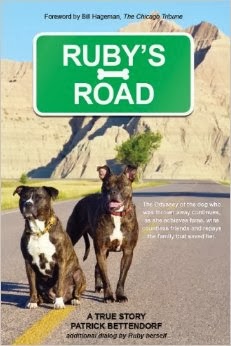
In RUBY’S TALE, author Pat Bettendorf chronicled the fate of a throwaway Pit Bull that rose from the mean streets to become a beloved service dog, national celebrity and the leader of his ‘Tribe’ of three humans and six rescue dogs. In RUBY’S ROAD, the writer and his eponymous heroine resume their adventures, winning heart and minds while grooming Sugar, a newcomer, who hopes to carry the load when Ruby decides to hang up her service vest. LIke the earlier book, this one revels in the day-to-day pleasure and treasures of the human-canine dynamic – a possum cornered in the yard, a turn onstage in a professional theater, a moving encounter with a misty-eyed WW II vet. These episodes underscore Ruby’s sweet, loving temperament, yet it’s clear that her human family is every bit as kind and caring, if a bit more chaotic. Thankfully, when disasters threatens to derail the Ruby express Ruby’s charisma, and anonymous angels combine to save the day. Like a home-baked pie, or wine with friends by the fireside, RUBY’S ROAD is the kind of feel-good book that goes down easy and leaves us feeling all is right with the world.
SGT. STUBBY – PIT BULL WAR HERO

 A few month’s back I wrote a short piece on Stubby, America’s first and most decorated war dog who happened to be a Pit Bull (no surprise to those of us who live with them). With Bullies once again getting hammered in the press, here’s a fuller picture of this amazing solider.  


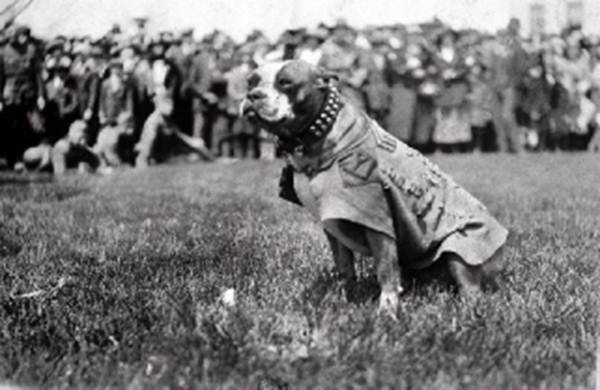
Sgt Stubby, was the most decorated war dog of World War I and the only dog to be promoted to sergeant through combat. One day he appeared at Yale Field in New Haven, Connecticut, while a group of soldiers were training, stopping to make friends with men as they drilled. Corporal Robert Conroy, developed a fondness for the dog. He named him Stubby because of his short legs. When it became time for the outfit to ship out, Conroy hid Stubby on board the troop ship. To keep the dog, the private taught him to salute his commanding officers warming their hearts to him. Stubby served with the 102nd Infantry, 26th (Yankee) Division in the trenches in France for 18 months and participated in four offensives and 18 battles. The loud noise of the bombs and gun fire did not bother him. He was never content to just stay in the trenches but eagerly went out, searched and found wounded soldiers. Stubby entered combat on February 5, 1918 at Chemin Des Dames, north of Soissons, and was under constant fire, day and night for over a month. In April 1918, during a raid to take Schieprey, Stubby was wounded in the foreleg by the retreating Germans throwing hand grenades. He was sent to the rear for convalescence, and, as he had done on the front, was able to improve morale. When he recovered from his wounds, Stubby returned to the trenches. 
After being gassed and nearly dying himself, Stubby learned to warn his unit of poison gas attacks, continued to locate wounded soldiers in no-man’s land, and since he could hear the whine of incoming artillery shells before humans could, he became very adept at letting his unit know when to duck for cover. He was solely responsible for capturing a German spy in the Argonne. The spy made the mistake of speaking German to him when they were alone. Stubby knew he was no ally and attacked him biting and holding on to him by the seat of his pants until his comrades could secure him. 
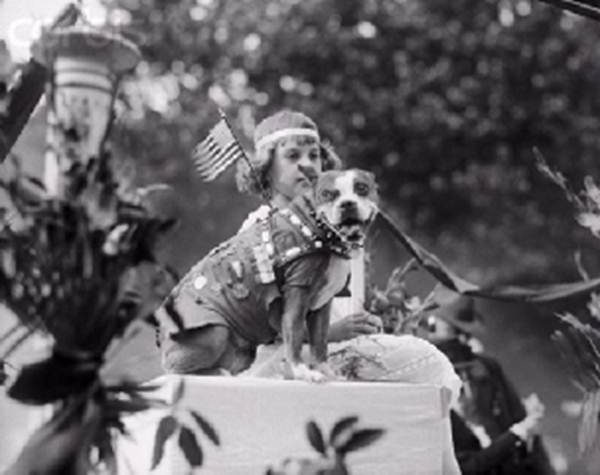
Following the retaking of Chateau-Thierry by the US, the thankful women of the town made Stubby a chamois coat on which were pinned his many medals. There is also a legend that while in Paris with Corporal Conroy, Stubby saved a young girl from being hit by a car. 

At the end of the war, Conroy smuggled Stubby home. Stubby became a celebrity and marched in and normally led, many parades across the country. He met Presidents Woodrow Wilson, Calvin Coolidge, and Warren G. Harding. Starting in 1921, he attended Georgetown University Law Center with Conroy, and became the Georgetown Hoyas’ team mascot. He would be given the football at halftime and would nudge the ball around the field to the amusement of the fans. Stubby was made a life member of the American Legion, the Red Cross and the YMCA. In 1921, the Humane Education Society awarded him a special gold medal for his service to his country. The medal was presented by General John Pershing. In 1926, Stubby died in Conroy’s arms. His remains are featured in “The Price of Freedom: Americans at War” exhibit at the Smithsonian in Washington DC. Stubby was honored with a brick in the Walk of Honor at the United States World War I monument, Liberty Memorial, in Kansas City at a ceremony held on Armistice Day, November 11, 2006. 

THE PRICE OF FAME (all work and no play…)

I hope Lou doesn’t mind but I thought I’d do this one on my own to voice a little complaint.  Don’t get me wrong, he’s a great dog daddy but he’s been super crazed with this book thing lately and so we haven’t been playing enough. Part of that was due to the recent rain (I might look tough but I really don’t like the rain, windy days or when it’s too hot – anything above 75 degrees) but most of it was because he’s been hunched over the machine he uses to make words, pounding on the keys, cursing something called MicroSoft (he’s really fond of this other thing, though, called Apple).  Now that the book is up on Kindle and almost ready to be printed, he seems to be calming down and getting back to his real business, which is taking me to the dog park, the beach and the churchyard next door. There, it felt good to get that off my furry chest.  

Before I go, I just had to share the coolest story about Pen Farthing, a former British Royal Marine, whose charity, NOWZAD, helped reunite adopted pets with soldiers and military contractors after they leave Afghanistan. Reuniting these dogs and cats with their soldiers takes planning worthy of covert ops, and it’s expensive:  Rescuing a dog can cost $3,500-$4,000, a cat, $2,500.  If you’re as moved by the article as we were, maybe you can make a contribution.
January 19, 2013|By David Zucchino, Los Angeles Times
KABUL, Afghanistan — She was just an ordinary brown mutt, a stray, but Pvt. Conrad Lewis loved her. Lewis, a British paratrooper in Afghanistan’s Helmand province, adopted the dog and named her Pegasus. Everyone called her Peg. In his letters home, Lewis described Peg as a member of his military family: “I have taught her to sit and give me her paw…. She patrols with us, she is not afraid of the Taliban or their bullets.”
A break from the book!
When Lewis was on Christmas leave in Britain in 2010, he told his father, Tony, that Peg was so important to him that he wanted to bring her home when he returned from his deployment. “That’s your job, Dad,” he said. Two months later, in February 2011, Pvt. Lewis was dead at 22, shot by a sniper.
Tony Lewis and his wife, Sandi, were determined to honor their son’s wish. A friend put them in touch with Pen Farthing, a former British Royal Marine whose charity, Nowzad, helps reunite adopted pets with soldiers and contractors after they leave Afghanistan.
The parents, the charity and Conrad’s fellow paratroopers hatched a plan: Peg was slipped aboard a military helicopter, then disguised as a military working dog. Afghan army soldiers were paid to deliver her to Kabul.
The Nowzad kennels in the Afghan capital nursed her back to health. Six months later, in November 2011, Peg leaped into the arms of Tony and Sandi Lewis in Claverdon, Warwickshire. “Having her here means so much to us,” Tony Lewis said on Thanksgiving Day. “She is a link to Conrad’s time in Afghanistan, a symbol of his sacrifice. She is something he loved, and we love her too…. She has his spirit.” (read the entire article)

AND THE OSCAR GOES TO…

I love movies and have been watching the Oscars since my teens, when I used to earn extra coin handicapping the winners, a skill I inherited from my dad.  Throughout the years, my dogs have kept me company, usually just hanging around, hoping that some party food will find it’s way to the floor.  Even Rebel, my majestic Irish Setter, never offered an opinion on the outcome.  Tanner was eager to share our steak dinner (he got a sliver of fat and some juice) but he was more interested in predicting the winners.  

Eugenie and were leaning toward Hugo, a moving, visually resplendent  fairy tale about making broken people whole.  There were other notable nominees, The Help,  Midnight In Paris and some clunkers (Tree of Life – what the…?) but Tanner was adamant:  Uggie would win for The Artist, a charming homage to conema’s silent era, and Cosmo for Beginners, a young man’s meditation on his father’s sexuality and illness.  Hugo also featured a dog, a Doberman, the canine sidekick of Sasha Baron Cohen who played the villain with a heart-of-gold, but he was a snarling, ornery bugger, the opposite of the cute, perky, indomitable Jack Russells.  Tanner was right.  Christopher Plummer earned Best Supporting Actor for Beginners and The Artist went on to cop Best Picture, Best Director and Best Actor.  According to Tanner’s unnamed canine sources, Uggie claimed he was happy for Jean Dujardin but he secretly felt that he’d been robbed.  

Instead of gloating, Tanner offered his thoughts about this year’s show and the lack of drama.  There were some very good movies like The Help and Midnight In Paris but most of those didn’t have top tier stars in the leads.  Then there were films with A-list names (Money BallIron LadyThe Descendants) that were good but not great.  Tanner says people get excited watching big stars carry big movies.  Kind of like watching Kobe or LeBron hit the game-winning shot.   He found it interesting that several films (Midnight, Hugo, The Artist, War Horse) had French locations or were set around the time of WW I.  He thinks it has to do with the economic downturn and a nostalgic yearning for distant, ‘better’ times.  Sorry, Woody.  Anyway, if the recession continues into next year, I’m thinking about putting down some cash on Tanner’s Oscar picks .


If you dig cinema and would like a more nuanced and intelligent analysis, check out my friend Dan Cohen’s blog.  Tanner often plays with his dog, Luna (pictured below).  I wonder if he stole his picks from her?  Hmmm.